
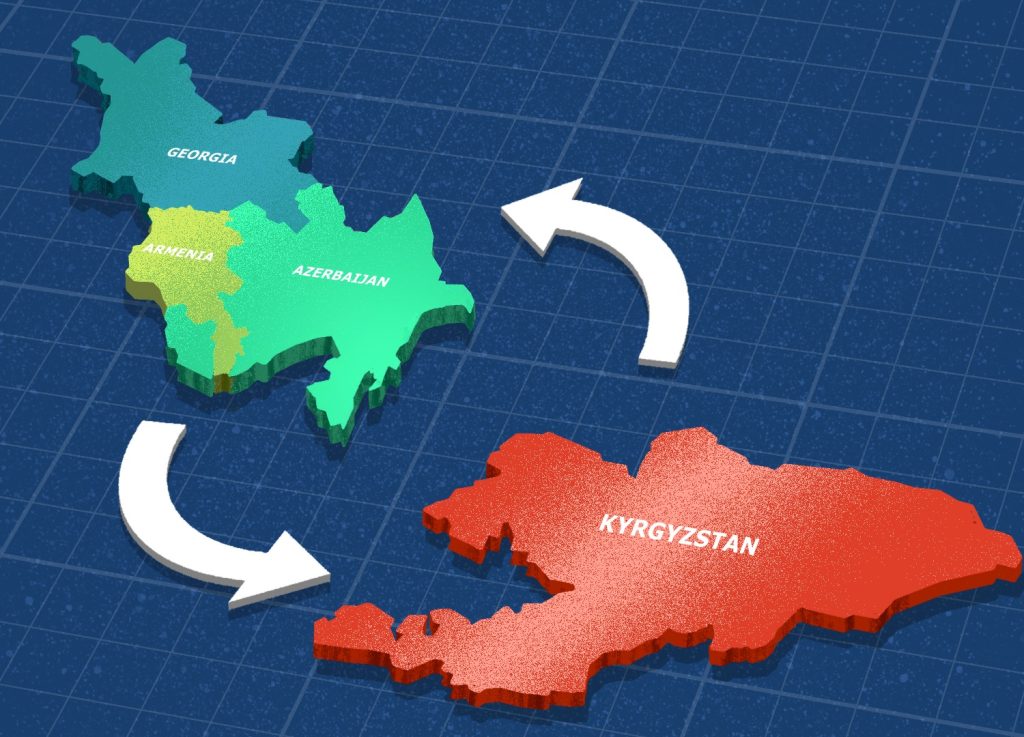
Kyrgyzstan has emerged as an active player in the South Caucasus, a region where it had little presence for most of the post-Soviet period. Kazakhstan, Uzbekistan and, to a lesser extent, Turkmenistan have driven connectivity and commercial ties between Central Asia and the South Caucasus. Bishkek is now pursuing the same course, and this summer it moved quickly: it hosted the first official visit by a Georgian prime minister in 34 years of diplomatic relations, signed a Treaty on Allied Relations with Azerbaijan, and opened talks with Armenia on the logistics that keep bilateral trade negligible. The engagement serves a larger strategy of transport diversification. A landlocked state whose trade runs almost entirely through China, or through Russia via Kazakhstan, wants a western route to the Caspian, the Black Sea and Europe.
A Georgian opening built on car trade
Georgian Prime Minister Irakli Kobakhidze’s visit on June 11–12 was the first official visit by a Georgian head of government since the two countries established relations in 1992. President Sadyr Japarov called Georgia “an important partner for Kyrgyzstan” with relations “built on mutual trust, respect, and long-standing cooperation.” Transport routes between Central Asia and the South Caucasus led the agenda, alongside exchanges in education, science, culture and sport. The two governments signed documents on aviation, education, veterinary services, justice and state property, along with an agreement on the advance exchange of information on goods and vehicles crossing between the two countries. They also opened talks on direct Tbilisi–Bishkek flights.
At the same time, the Kyrgyz-Georgian Intergovernmental Commission on Trade and Economic Cooperation met in Bishkek, resuming its work after a ten-year hiatus. In August, Interior Minister Ulan Niyazbekov led a Kyrgyz delegation to Tbilisi for talks with Kobakhidze on security cooperation.
Trade figures make Kyrgyzstan look like one of Georgia’s most important economic partners. Bilateral trade exceeded $1.4 billion in 2025, according to Georgia’s national statistics office, and Kyrgyzstan was Georgia’s largest export market. Almost all of it is cars. Between January and August 2026, Georgia re-exported 14,700 passenger cars worth about $551 million to Kyrgyzstan, 95.4 percent of its total exports to the country. The trade took off after Russia’s full-scale invasion of Ukraine, as used vehicles from Europe and the United States moved through Georgian ports to Central Asia and, in large part, on to Russia. The average declared value of a car bound for Kyrgyzstan this year was about $37,500, nearly two and a half times the figure for cars bound for Kazakhstan, a gap that points to vehicles destined for buyers well beyond the Kyrgyz market. Total Georgian exports to Kyrgyzstan fell 38.8 percent year on year over the same eight months.
Strip out the cars and the bilateral exchange is modest: Georgian fertilizers, mineral water and wine against Kyrgyz agricultural produce and textiles. Distance and the need for multimodal routes remain the main obstacles to broader trade, and the car trade depends on Russian demand and sanctions enforcement that neither government controls. The transport agenda launched in June is an attempt to give the relationship a more durable base. For Tbilisi, Kyrgyzstan also carries diplomatic value in Central Asia, a region where Georgia has expanded its engagement rapidly this year.
Baku, the indispensable partner
Closer ties with Georgia make strategic sense for Bishkek only if ties with Azerbaijan advance in parallel, and Azerbaijan has become Kyrgyzstan’s most consequential partner in the region. The relationship grew out of cultural affinity and Turkic solidarity under the Organization of Turkic States, but it has acquired real economic, investment and geopolitical substance. The clearest indication came on July 31, when Japarov and Ilham Aliyev signed a Treaty on Allied Relations in Cholpon-Ata during Aliyev’s state visit. The treaty caps a relationship formalized as a strategic partnership in 2022 and deepened during Japarov’s state visit to Baku in April 2024. The accompanying package of agreements covered transport, energy, cybersecurity, education, financial market regulation and the circulation of precious metals.
Geography explains the priority. Azerbaijan gives Kyrgyz cargo a landing point on the western Caspian and onward access to Georgia and Turkey. Alat port, the Baku-Tbilisi-Kars railway and the Azerbaijani-Georgian transport network form the western backbone of the Middle Corridor. Cargo reaching Azerbaijan from Central Asia continues either to Georgia’s Black Sea ports or by rail through Georgia into Turkey. Any realistic China-Kyrgyzstan-Europe route crosses Azerbaijani territory, which places Baku at the center of Kyrgyz calculations.
The relationship has also moved beyond transit. The Azerbaijan-Kyrgyz Development Fund has become one of the most tangible links between the two economies. Approved in 2022 with initial capital of $25 million, it was expanded to $100 million in 2024 and, under agreements reached during Aliyev’s July visit, to $200 million; the Kyrgyz cabinet approved the increase in September. The fund is financing or reviewing projects in energy, housing, textiles, healthcare and construction materials. It is one of only four joint development funds Kyrgyzstan operates with foreign governments.
Armenia: willing, but off the route
Armenia occupies a much smaller place in Kyrgyzstan’s South Caucasus policy, though both countries belong to the Eurasian Economic Union. Kyrgyz official statistics put bilateral trade at 308.6 million soms in 2025, roughly $3.5 million. The obstacle is geographic: unlike Azerbaijan and Georgia, Armenia offers Kyrgyzstan no established east-west transit chain.
Political engagement has nonetheless intensified. Japarov met Armenian President Vahagn Khachaturyan in April to discuss direct flights, business ties, agriculture and technology, then met Prime Minister Nikol Pashinyan in Cholpon-Ata on August 7, on the sidelines of the Eurasian Intergovernmental Council. Pashinyan was blunt: “due to logistical problems, the volume of our mutual trade is not very large.” The numbers have started to move. Armenian data show bilateral trade nearly tripled in January–May 2026, in the same months that Russian restrictions on Armenian produce pushed Yerevan toward other EAEU markets.
Armenia’s significance could grow if Armenian-Azerbaijani normalization reopens regional communications. The Trump Route for International Peace and Prosperity (TRIPP) across southern Armenia, and the wider reopening of links among Armenia, Azerbaijan and Turkey, would give Central Asian states another westward route. From Bishkek’s perspective, it would supplement the Azerbaijan-Georgia corridor as an additional connectivity option.
A landlocked state looks west
Kyrgyzstan’s interest in the South Caucasus reflects shifts in regional geopolitics, above all the reordering of transport across Eurasia. Russia’s war on Ukraine disrupted the traditional commercial routes linking China and Central Asia with the European Union and focused attention on the Middle Corridor, which had existed since the 1990s without becoming a major overland artery. Since 2022, the countries along the route have worked to expand and modernize its railways and ports. Much remains to be done before it can compete with the northern route through Russia and with maritime shipping via the Indian Ocean. Instability around Iran, the Persian Gulf and the Bab al-Mandeb has nonetheless raised the corridor’s value.
Discussion of the Middle Corridor usually centers on Kazakhstan and Uzbekistan, Central Asia’s two largest economies, but the region’s smaller states have also sought engagement with the South Caucasus, and Georgia has courted them actively. After Bishkek, Kobakhidze traveled to Dushanbe on June 19–20, where the two sides signed a joint communiqué and an agreement establishing an intergovernmental economic commission, and on July 3 in Tbilisi hosted Shavkat Mirziyoyev to sign a declaration establishing a strategic partnership. Turkmen President Serdar Berdimuhamedov’s state visit to the Georgian capital on July 16–17 produced railway and maritime cooperation agreements, and Ashgabat is developing cross-Caspian connectivity and energy ties with Baku.
Kyrgyzstan is a latecomer to these dynamics, and geography complicates its outreach. Like Tajikistan, it is applying the same logic: diversifying its trade routes away from near-exclusive dependence on China and on Russia via Kazakhstan. The strategy has several strands. Bishkek looks to Pakistani ports in the south and Georgian ports in the west for sea access, and it aims to recast itself from a landlocked country into a transit one. The China-Kyrgyzstan-Uzbekistan railway is central to that ambition. Construction is underway on the roughly 305-kilometer Kyrgyz section, where crews broke through the first tunnel in September. Once complete, the line would link Kyrgyzstan to the Middle Corridor and make the South Caucasus its bridge to the EU market, particularly through Georgia’s planned deep-sea port at Anaklia, which the government expects to begin operating in 2029.
Kyrgyzstan’s engagement with the South Caucasus has entered a qualitatively different phase. For much of the post-Soviet period, Bishkek’s relations with Georgia, Armenia and Azerbaijan were cordial but peripheral. Geography, limited trade and Kyrgyzstan’s heavy economic and security orientation toward Russia kept the region at the margins of Kyrgyz foreign policy. The transformation of Eurasian transport routes, the growing importance of the Middle Corridor, closer cooperation with the Turkic world and the construction of the CKU railway are now pulling Bishkek westward toward the Caspian. Kyrgyzstan remains in the EAEU and the Collective Security Treaty Organization, and China remains its largest source of imports. Its South Caucasus policy is meant to ensure that none of them represents its only geographic choice. The durability of that policy will depend on whether cargo follows the treaties, and in Georgia’s case on whether trade beyond re-exported cars grows as that windfall shrinks.
Emil Avdaliani is a Research Fellow at the Turan Research Center and a professor of international relations at the European University in Tbilisi, Georgia. His research focuses on the history of the Silk Roads and the interests of great powers in the Middle East and the Caucasus.
