
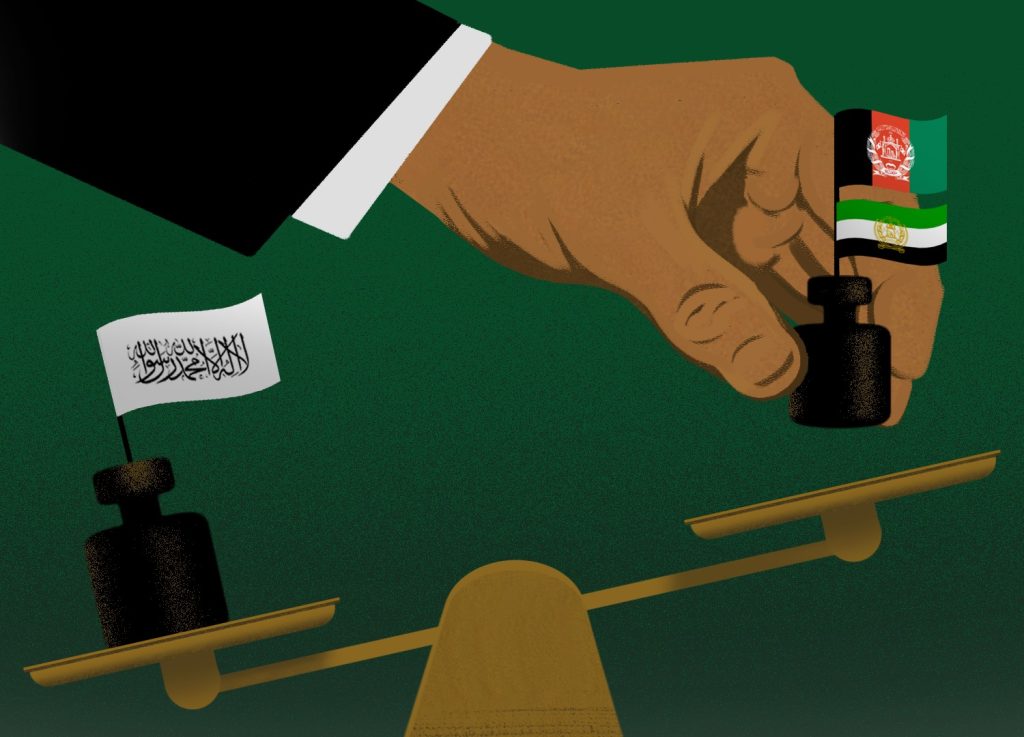
Illustration by Dinmukhamed Kairulla.
Five years after the Taliban returned to power, Afghanistan looks increasingly different from the country Pakistan expected to emerge in 2021. The Taliban remains firmly in control, but its relationship with Islamabad has deteriorated into something much more serious than a dispute over the border or the Tehrik-e-Taliban Pakistan (TTP). At the same time, Afghan groups opposed to the Taliban have become more active, and Pakistani officials and security figures appear to be talking to some of them. None of this proves that Pakistan has decided to sponsor a new armed insurgency. But taken together, these developments suggest that Islamabad is beginning to prepare for an Afghanistan in which the Taliban may no longer be its only option.
That is an important change for India. New Delhi has spent the past year doing almost the opposite: deepening its engagement with Kabul and accepting that, for the foreseeable future, the Taliban is the government it must deal with.
Pakistan and the Afghan Taliban
Pakistan’s relationship with the Taliban was once relatively straightforward. In the 1990s, Islamabad backed the Taliban while India, Iran and Russia supported the Northern Alliance. Pakistan saw the Taliban as a way to secure influence in Kabul and keep India from establishing a strategic foothold in Afghanistan.
When the Taliban returned to power in 2021, many in Pakistan initially regarded it as a strategic victory. But the Taliban proved less amenable to Pakistani influence than Islamabad had expected. The central dispute has been the Tehrik-e-Taliban Pakistan (TTP), which Pakistan accuses the Taliban of allowing to operate from Afghan territory. Kabul rejects the charge and has resisted Pakistani demands for action. Disputes over the Durand Line and border management have compounded the problem.
The consequences have gone well beyond diplomacy. Fighting in October 2025 produced some of the most serious clashes between the two countries since the Taliban takeover, followed by failed talks in Istanbul. In February and March 2026, Pakistan again carried out airstrikes inside Afghanistan. A UNAMA assessment recorded 372 Afghan civilians killed and 397 injured in cross-border fighting during the first three months of 2026. Pakistan subsequently resumed military operationsafter a temporary pause in March. In June the direction of fire reversed: Kabul struck targets inside Balochistan and Khyber Pakhtunkhwa, the first offensive operations the Taliban government has conducted on Pakistani territory.
The conflict has therefore changed the question facing Islamabad. It is no longer simply how to persuade the Taliban to manage the border or restrain the TTP. It is increasingly how to regain leverage over a Taliban government that Pakistan once expected to influence.
A January commentary for RUSI reported that Pakistan and political opponents of the Taliban, including Ahmad Massoud’s National Resistance Front (NRF), had maintained secret contacts.
But the same commentary offers an important counterweight to the hedging thesis: Pakistan may have neither the domestic capacity nor the regional backing to engineer regime change. Afghanistan’s opposition remains fragmented, lacks the external military and financial support enjoyed by the Northern Alliance in the 1990s, and many Afghan political figures continue to favor dialogue rather than another civil war.
That makes the reported contacts more interesting, not less. Islamabad may not be preparing to overthrow the Taliban. It may instead be buying strategic optionality.
New Lines Magazine reported that Pakistan was “shopping around for a new Afghan partner,” while Afghanistan International reported meetings in Pakistan involving former Afghan parliamentarians and Pakistani security officials.
The Taliban itself now openly alleges that Pakistan is supporting its opponents. In a recent interview with Deutsche Welle, Taliban spokesman Zabihullah Mujahid accused Pakistan of supporting insurgents in Afghanistan.
The allegation is not independent evidence of Pakistani military assistance. But it demonstrates how Kabul now views Islamabad: not simply as a hostile neighbor, but as a potential external source of support for its opponents.
Islamabad’s political opening
The most visible public expression of this shift came with the “Towards Unity and Trust” dialogue in Islamabad in September 2025. The gathering brought together former Afghan officials, political figures, women’s-rights activists and civil-society representatives. It was organized by Afghan civil-society actors rather than formally hosted by the Pakistani government.
Former U.S. special envoy Zalmay Khalilzad subsequently said the meeting had been convened at the request of Pakistani intelligence, an allegation that Islamabad has not publicly accepted. That claim is significant precisely because it offers an alternative interpretation of what otherwise could be dismissed as an Afghan diaspora meeting.
The initiative later continued in London in March 2026, where around 40 Afghan political and civic representatives participated, followed on the second day by discussions with British parliamentarians, diplomats and organizations working on Afghanistan. There was no reported Pakistani role in the London meeting.
Taken together, the meetings show something less dramatic than the creation of a Pakistani proxy: Afghan opponents are attempting to build a wider political network, while Pakistan has demonstrated a willingness to give at least some of them political space.
An emerging Afghan resistance
In recent weeks, the Afghanistan Freedom Front (AFF), National Resistance Front and newly established Afghanistan United Front have claimed attacks against Taliban forces in a widening geographic area. Reports have documented attacks in Badakhshan, Kunduz, Baghlan, Faryab, Herat, Kabul, Ghor, Kandahar and Helmand. One compilation counted 19 claimed attacks across nine provinces between July 30 and August 9, although the casualty figures and operational claims came from the groups themselves and were not independently verified.
The Afghanistan United Front, led by Sami Sadat, a former corps commander who served briefly as chief of the Afghan army staff in August 2021, has claimed operations in Kandahar and Helmand, while the AFF and NRF have reported attacks in northern and northeastern provinces.
This does not amount to a new Northern Alliance. The groups remain politically and militarily fragmented and have not demonstrated an ability to hold territory for sustained periods.
Nor should all anti-Taliban violence be placed in the same category. ISKP remains the deadliest armed enemy of the Taliban but is not part of the political opposition represented by the NRF or AFF. The distinction is essential when assessing the nature and scale of the resistance.
Badakhshan
Badakhshan has become the clearest example of why the Taliban’s problem cannot simply be reduced to opposition groups operating from outside the country.
Juma Khan Fateh, a former Taliban deputy governor of Zabul, became embroiled in a dispute with Kabul over his removal, local authority and control of mining revenues. His followers fought Taliban forces in Nusay for the better part of a week before he surrendered on August 17 and was taken to Kabul. This is better understood as an internal Taliban power struggle than as straightforward anti-Taliban resistance. The speed with which Kabul shut it down, committing airstrikes and special forces against a single disaffected commander, says as much about the movement’s capacity to contain such challenges as the episode does about its vulnerability to them.
More revealing are attacks that cannot easily be explained through Fateh’s faction. On July 28, Badakhshan’s director of information and culture, Zabihullah Amiri, was killed in a targeted shooting. Two weeks later, Faizabad Mayor Habibur Rahman Mansoor was killed in a vehicle bombing; the NRF claimed responsibility for the latter attack.
Badakhshan’s importance lies in the combination of local ethnic grievances, competition over lucrative mineral resourcesand resistance to the centralization of power in Kandahar. It is a harder problem for the Taliban than opposition figures issuing statements from abroad because it involves local networks and disaffected actors inside the Taliban’s own governing structure.
The Tajikistan dimension
Tajikistan’s border with Afghanistan is a standing preoccupation for Dushanbe and for the Collective Security Treaty Organization. During the fighting in Nusay, Afghanistan International reported that Fateh’s fighters had shot down a Taliban helicopter. Fire from Afghan territory crossed into Tajikistan’s Darvoz district and killed a 21-year-old woman, according to Tajik authorities. Dushanbe protested to the Taliban over the killing, over damage to houses and over the violation of its airspace.
The episode illustrates why Badakhshan matters beyond Afghanistan’s internal politics. The province borders Tajikistan, and instability there touches a country already deeply concerned about militant threats emanating from Afghanistan.
For India, the broader signal is that the emerging resistance is not simply a Pakistan-Taliban story. Northern Afghanistan connects the Taliban’s internal cohesion to Central Asian security, while Pakistan’s conflict with Kabul creates a separate pressure point from the south and east.
China’s failure to break the deadlock
China has tried to mediate between Islamabad and Kabul, driven partly by its security concerns and substantial economic interests in Pakistan. Beijing helped bring the two sides together in Urumqi and dispatched its special envoy for Afghanistan, Yue Xiaoyong, to Kabul and Islamabad.
Yet Chinese mediation has so far failed to resolve the fundamental dispute. Pakistan wants tangible action from Kabul against the TTP; the Taliban rejects Islamabad’s demands and questions Pakistan’s military actions. After a gap of several months, Beijing pushed again for dialogue.
China’s difficulty is revealing. Even a country with strong relationships with both sides and substantial economic leverage has struggled to bridge the security dispute. Pakistan’s problem with the Taliban is therefore becoming less amenable to traditional diplomatic management.
India and the Taliban
Over the past year, New Delhi has moved decisively toward Kabul rather than maintaining equal distance from the Taliban and its opponents. India upgraded its Kabul technical mission to a full embassy in October 2025.
In January 2026, Taliban-appointed diplomat Mufti Noor Ahmad Noor took charge as Afghanistan’s chargé d’affaires in New Delhi, while Taliban-appointed officials have taken responsibility for the Mumbai and Hyderabad consulates.
The symbolism sharpened on August 17, when India’s joint secretary for the Pakistan-Afghanistan-Iran desk, Anand Prakash, attended the Taliban’s fifth-anniversary reception at the Afghan embassy in New Delhi; while, in a similar event in Islamabad, no Pakistani official was present.
India’s deeper engagement with Kabul has also coincided with a weakening of one of its principal alternative routes into Afghanistan. The U.S. sanctions waiver for Chabahar expired on April 26, 2026, while India has said it has fulfilled its $120 million equipment commitment and is still engaging with stakeholders over the port’s future.
The result is a striking paradox. India’s position in Kabul is stronger, but its physical access to Afghanistan remains constrained. New Delhi has increased diplomatic engagement precisely as the regional infrastructure that once allowed it to bypass Pakistan has become more uncertain.
That makes Pakistan’s new relationship with the Afghan opposition consequential for India. If Islamabad develops a durable association with the NRF or other resistance groups, it could complicate India’s already narrow political space. Ahmad Massoud has publicly called Pakistan a “brotherly country” and has signaled openness to dialogue, illustrating that the opposition itself may be willing to engage Islamabad.
The effect is that Islamabad and New Delhi have arrived at the same address by opposite routes. Both must now deal with the Taliban as the only government in Kabul, but they want different things from it and hold it on different terms. Pakistan is bargaining with a former client it can no longer direct, while quietly examining alternatives in case the leverage never returns. India is building on access to a government it once refused to speak to, having concluded that the alternatives are weaker than the incumbent. One is dealing with the Taliban while hedging against it. The other has stopped hedging.
That may be the most consequential development five years after the Taliban’s return. Pakistan and India, once on opposite sides of Afghanistan’s internal conflict, are now approaching the Taliban from different directions. Whether their parallel engagement produces greater regional stability or simply prepares the ground for a new contest over influence will depend largely on what Pakistan does next.
What Would Settle the Question
The reading advanced here rests on ambiguous evidence and should be treated as testable rather than settled. Four developments over the coming months would tell against it or confirm it.
The first is what becomes of Pakistani contacts with the opposition if relations with Kabul improve. Hedging is provisional by definition. If a durable understanding on the TTP is followed by a quiet end to the meetings, the contacts were leverage. If they survive a thaw, they were strategy.
The second is whether the armed groups change character. Raids and assassinations require little outside help. Taking ground, holding it, sustaining supply and operating through a winter require a great deal. A resistance that begins to hold territory is a resistance that has found a patron, and the question of whose becomes answerable rather than speculative.
The third is whether the opposition’s own posture toward Islamabad hardens or softens. Ahmad Massoud’s overtures carry a cost inside Afghanistan. Whether other figures follow him or take visible distance from him will indicate how much appetite there is on the Afghan side for a Pakistani relationship.
Until those questions resolve, the accurate description of Pakistan’s position is not that it has chosen a new Afghan policy. It is that it has stopped assuming it can rely on the old one.
Hussain Ehsani is a Research Fellow at the Turan Research Center. He previously was a senior researcher at the Afghan Institute for Strategic Studies. He holds a master’s degree from the University of Tehran.
