
“Ocean of Peace”—an expression being bandied about by a handful of Pacific Island leaders—brings to mind the title of an early 1960s musical, “Stop the World, I Want to Get Off.”
The main idea behind “Ocean of Peace” is that the Pacific region can opt out of so-called “great power rivalry” and avoid much of the unpleasantness that afflicts the rest of the globe. Some commentators call for a regional security agreement to keep order.
Good luck with that.
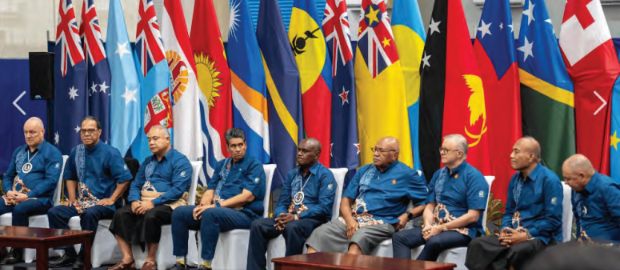
Fijian Prime Minister Sitiveni Rabuka apparently coined “Ocean of Peace” in 2023, and Pacific Island leaders then adopted it at their annual Pacific Island Forum (PIF) meeting in 2025 in Solomon Islands.
However, the phrase is more something you’d see on a car bumper sticker. How it translates into a widely accepted security framework either locally or globally is unclear.
The Pacific Ocean is a big place with very different peoples and nations, each with sovereign interests. The region has never been exceptionally peaceful—including among Pacific islanders. Just ask the Fijians about the Tongans.
More recently, there was an inability to reach even diplomatic agreement on a Pacific Island Forum (PIF) statement condemning a Chinese missile test in the region.
Surely at a minimum an “Ocean of Peace” could agree this is bad? The most Pacific leaders (six of whom did not, or could not, show up at the PIF in Palau in late August) could manage was an expression of “concern” with no mention of China. Nauru opposed the entire statement and Kiribati avoided the meeting where the matter was discussed.
Both are under Beijing’s thumb.
GREAT POWER RIVALRY?
Being under pressure from Beijing is different from the usual “great power rivalry” framing in which China and the United States use the Pacific to carry out their rivalry—via military deployments, infrastructure, policing arrangements, and access agreements.
In this framing, the rivalry spills over into coercion or instability among otherwise uninvolved Pacific Island states.
However, this gives the impression that China and U.S. are the only two major actors and that there is some equivalency.
One is hard-pressed to name a recent example of American coercion of anybody in the region, or of US-caused instability.
Rather, China’s attempts to do in the Pacific region what the Japanese did in the 1920s and 1930s (but without any of the positive aspects) and create vassal states, are the major sources of coercion and instability in the Pacific today.
Just one example, recall China’s repeated use of “tourism” as a weapon to collapse the Palau economy and coerce the government of Palau. Additionally, its efforts to interfere with the recent PIF meeting in Palau extended to personally threatening Palau’s President Surangel Whipps Jr. and close family if they did not follow Beijing’s dictates regarding Taiwan’s participation in the PIF.
Another huge source of instability and societal destruction throughout the region is Chinese organized crime and corruption (including flooding the region with drugs) that is part and parcel of the Chinese Communist Party’s modus operandi for gaining influence. As is the “elite capture” Solomon Islands Prime Minister Matthew Wale spoke about recently.
For more, read then-FSM President David Panuelo’s public letters detailing Chinese coercion and subversion in the Federated States of Micronesia (FSM) and you’ll have a point-by-point indictment of the PRC and its efforts to dominate, disintegrate and destroy a nation’s consensual government and sovereignty.
The 2025 Annual Report of the U.S.-China Economic and Security Review Commission’s section on the Pacific Islands gives myriad more examples of unilateral unrestricted warfare attacks by the PRC.
The attacks are pervasive and evident across society, economics and politics in the Pacific. As another example, Chinese attempts to subvert Pacific media are well documented in a 2026 Center for Naval Analysis (CNA) report.
This is not “rivalry”. This is an attack by one nation against the democratic, economic and social institutions of many others across the region.
Read the rest at The Sunday Gaurdian
Grant Newsham is a Senior Fellow at Yorktown Institute.

