
In March 1783 Gen. George Washington put down a conspiracy among some of his officers who wanted to mutiny against Congress. During the War of Independence, he agreed with his officers’ discontent with Congress but equated rebellion against Congress with treason: “This dreadful alternative of either deserting our country . . . or turning our arms against it, which is the apparent object, unless Congress can be compelled into instant compliance, has something so shocking in it that humanity revolts at the idea.”
The professionalism of the American military remains essential for the survival of a democratic republic. Most Americans don’t fear a military coup d’état, because they are confident that the armed forces’ loyalties lie with the Constitution. Abstaining from partisan politics—many officers even decline to vote—also helps explain the military’s high approval rating among the American people.
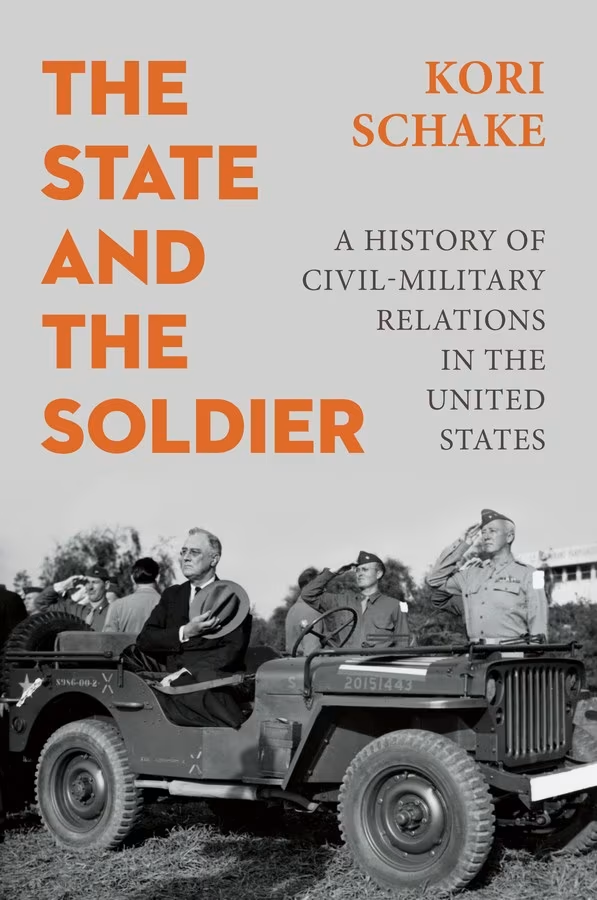
In “The State and the Soldier,” Kori Schake, who directs foreign and defense policy at the American Enterprise Institute, traces these tendencies to the Founders’ worries about an army so powerful that it could subvert republican government. Thirteen of the 85 Federalist Papers wrangle with how best to handle this threat, she notes in her history of American civil-military relations. The Constitution mandates that Congress “maintain a Navy” and allows—but doesn’t require—it to “raise and support Armies.”
Throughout history, standing armies had undermined liberty. Unlike in ancient Rome, where the norms dividing civil and military deteriorated, in America they became stronger. Thomas Jefferson selected officers based on partisan loyalty, but today, Ms. Schake observes, senior officers are mostly unaffiliated with a party.
In the 19th century, Americans frequently elected victorious generals—Andrew Jackson, Ulysses Grant, Zachary Taylor—as president. They only elected one, Dwight Eisenhower, during the next century. John McCain, a long-serving senator, lost the 2008 presidential race despite his status as a military hero. In 1964 Americans handed Sen. Barry Goldwater, a major general in the Air Force Reserve, one of the greatest electoral defeats in history, largely because they distrusted his strategic judgment.
Read the rest at WSJ.
Shay Khatiri is a vice president and senior fellow at Yorktown Institute.
