
Crisp against the gloaming, a bugle sounds a rising then falling strain.
It’s 5 pm. It’s cold. Yet in the nation’s capital, something embers. While DC’s iPhone-occupied evening toilers and travelers scurry about to their next diversion, the lone uniformed Doughboy standing at 1400 Pennsylvania Avenue signals a time-honored but incongruous musical thought of reflection for day’s ending.
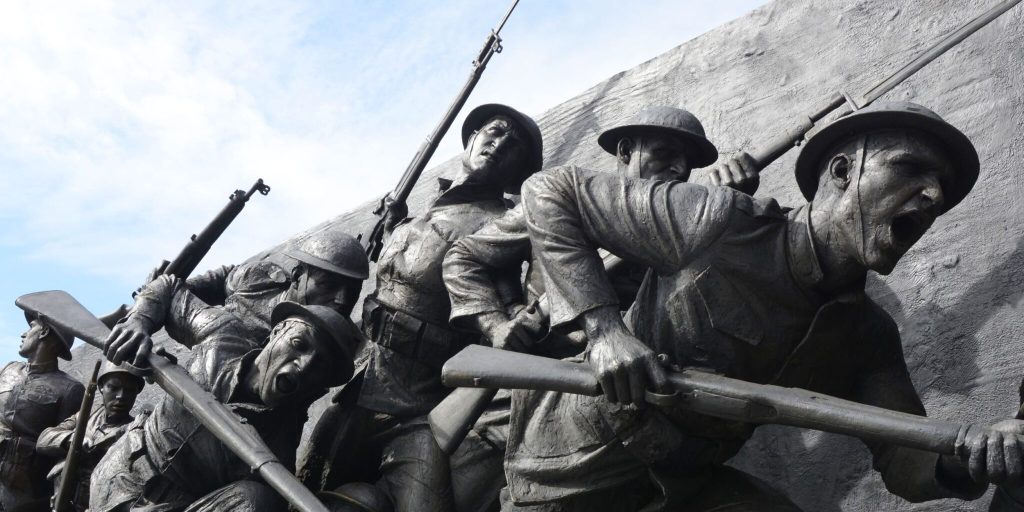
My feet or my heart or my head have drawn me back here again, to the inscribed words, the murmuring water splatting, and the parading in bronze—of the human, and of the nation—that all together make up America’s newest national monument, the National World War I Memorial, at Pershing Park.
Alongside its American precursor, the French version of “Taps,” la sonnerie “Aux Morts,” was sounded. Dignified French and American speakers at the event reminded their audience that between their respective militaries is the “oldest continuous military friendship our [American] nation has ever known.” Such words are fitly sounded here, mere steps south from Lafayette Square and the White House, and within the statuesque hearing of the general tasked with America’s arguably first physical repayment of its Revolutionary War debt to France, with Pershing’s command of the American Expeditionary Forces (AEF) onto French soil.
Since 1862, “Butterfield’s Lullaby”—better known as “Taps”—has sounded across US military installations each evening to signify the close of the day, as also to remind their members to honor by a moment of recollection those who have given their lives for the nation. Since May 24, 2021, Taps has also each evening sounded from this juncture. Inspired by the nightly sounding of the “Last Post” at the Menin Gate in Ypres, Belgium, and at the Australian War Memorial in Canberra, Australia, the National WWI Memorial is the only memorial in the United States to host daily Taps by a live performer. Individuals can even entwine themselves into the Memorial’s living history by sponsoring a daily performance/bugler, honoring a veteran(s) of their choosing in the process.
Taps is the twenty-four note secular “Nunc Dimitis” for the sleeping soldier, while the last bugle call of the day, it gives promise of reveille. The tradition harkens back to ancient sunset rites, performed to ensure the sun’s return. No wonder Taps is also, famously, played at every American military funeral—evenings and funerals alike, bearing witness to endings and the hope of renewal. Is such the promise, too, to a nation, of the national memorial?
For those approaching from the White House direction, the outward-facing raised inscription on the west side, on the granite wall which doubles as the “Peace Fountain,” seems to introduce a similar question with this challenge pulled from ambulance driver cum artillery officer Archibold MacLeish’s poem, “The Young Dead Soldiers Do Not Speak”:
Whether our lives and our deaths were for peace and a new hope
Or for nothing, we cannot say, it is you who must say this
They say we leave you our deaths, give them their meaning
We were young, they say, we have died, remember us.
Give our deaths meaning. Remember us. I’m struck suddenly by whether this request gives voice to the individual combat soldier silenced by the imperious Pericles in Thucydides’ famous version of the Athenian Funeral Address of 431 BCE. Then, Pericles had insisted that it was the glory of all those dead soldiers to remain nameless and anonymous behind the name of Athens. Since Athens was the “school of all Hellas,” it was enough that they had died expanding Athens’ glory. But Americans have always wanted to know who their soldiers were. Hence, national cemeteries and the creation of the “dog tag.” Hence, each individually carved name or presence on each headstone in every national cemetery. Hence, each of the 58,000 inscribed names on Maya Lin’s Vietnam Veterans Memorial is further down Constitution Avenue. Citizenship, for us, is never merely collective.
Read the rest at Law & Liberty.
Rebecca Burgess is a Senior Fellow at Yorktown Institute.
