
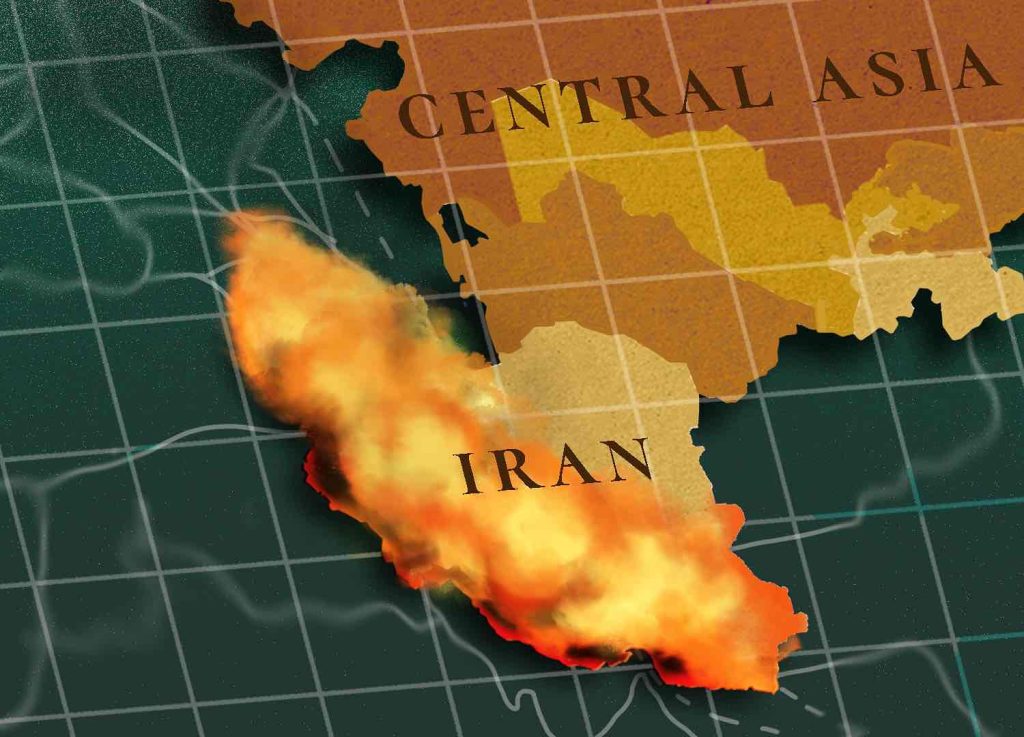
Illustration by Dinmukhamed Kairulla.
A Recalibration Already Under Way
Central Asian governments began repricing Iran before they said so. Within weeks of the opening of the American and Israeli strike campaign in February 2026, Uzbekistan, which moved a large share of its European and Turkish transit through Iranian territory, instructed its ministries to identify alternatives. Tajikistan absorbed an Iranian food export ban in March. Turkmenistan, Uzbekistan and Tajikistan sent humanitarian aid to Tehran, while Kazakhstan and Uzbekistan had sent their presidents to Washington days before the first strikes. No common regional position emerged, and no serious attempt was made to construct one.
This is not drift. It is a differentiated hedge, and it is a more sophisticated response than the commentary now urging Central Asia to distance itself from Tehran. That advice is roughly right and analytically empty. It does not tell governments what to do in the places where distance is not physically available, and those places are where the exposure actually sits.
The sharper claim is this. The range of plausible Iranian futures has widened faster than the expected value of any relationship with Tehran has fallen. When variance rises that quickly, no fixed Iran policy can be optimized against it, because the policy that pays under one trajectory loses under the next. The rational response is not to choose between engagement and distance but to buy optionality: shorten commitments, keep substitutes warm, refuse irreversible investment, and accept a higher running cost in exchange for the ability to change course. Central Asian states are already doing this. The open question is whether they can afford it, and the answer is less comfortable than the distancing argument suggests.
What the Old Strategy Got Right
The pragmatic model was not naive. It rested on five conditions, four of which held for three decades.
Iran offered the shortest route from landlocked Central Asia to open water. The International North-South Transport Corridor, founded by Russia, Iran and India in 2000 and later extended along a western branch through Azerbaijan, a trans-Caspian branch, and an eastern branch through Kazakhstan and Turkmenistan, reaches the Persian Gulf at Bandar Abbas and the Indian Ocean at Chabahar. Chabahar carries strategic weight precisely because it lies on the Gulf of Oman rather than the Persian Gulf. It is Iran’s only oceanic deep-water port and the one node in the system that a closure of the Strait of Hormuz would not sever.
Engagement with Tehran also fit a broader practice of balancing among the United States, China, Russia and the European Union. Iran was one vector among several, not an ideological commitment, and it was priced accordingly.
Tehran, for its part, behaved differently in the north than in the Middle East. It courted the post-Soviet states as a conventional regional power, mediated in the Tajik civil war, aligned with Moscow over Chechnya, and subordinated ideological export to trade. That record deserves qualification rather than repetition. Dushanbe’s 2015 suppression of the Islamic Renaissance Party and the rupture with Tehran that followed, and the later opening of an Iranian drone production line on Tajik territory, show that northern restraint was a policy choice rather than a structural feature, and one Iran has revised when it suited.
Geography created energy interdependence that no policy decision can dissolve. Iran’s northern consumption centers are poorly connected to its southern fields, so Turkmen gas has long supplied the Iranian north. Direct sales collapsed in the 2016-17 pricing dispute, but the relationship did not end; it changed form. Turkmen volumes now cross Iran under swap to Azerbaijan and Iraq, and a Turkmengaz arrangement moves up to two billion cubic meters a year to Turkey by the same mechanism. The Caspian oil analogue proved more fragile: Kazakhstan’s swap through the northern port of Neka effectively lapsed in 2010-11 over Iranian transit fees and has never returned at scale, despite repeated Iranian proposals to revive it.
Finally, linguistic and historical ties, above all with Tajikistan, supplied a cultural channel that carried little political cost.
The fifth condition was the one that mattered, and it was never a property of Iran at all. It was separability: the assumption that commerce with Tehran could be insulated from the security file. Western behavior reinforced it. Even the Joint Comprehensive Plan of Action of 2015 was built on the premise that sanctions relief and containment could coexist. Central Asian planners drew the reasonable inference that Middle Eastern conflict would stay in the Middle East.
What 2026 Changed
Separability failed as a physical fact before it failed as a policy assumption. American and Israeli strikes on Iranian nuclear and missile infrastructure began on 28 February 2026 and drew Iranian retaliation against Israel, American bases and targets in Arab states. A conditional ceasefire held from 8 April until early July, when attacks on commercial shipping in the Strait of Hormuz brought renewed American strikes and the collapse of the truce. Further waves followed through late July, with negotiations resuming in early August around a memorandum on reopening the Strait.
The transmission into Central Asia was immediate and non-theoretical. Southern corridors became unusable or uninsurable for extended stretches, freight rerouted at higher cost, and the North-South corridor ceased to function as a planning assumption. For states whose access to the sea runs through other people’s territory, a corridor that works only between escalations is not a corridor.
Variance, Not Direction
Much of the current analysis argues that Iran now generates unacceptable risk whether it collapses, endures, wins or loses. A proposition that survives every possible outcome is a disposition rather than a finding, and it gives planners nothing to work with. The four trajectories do not produce the same risk. They produce different risks, and that difference is the point.
A weakening or collapsing Iranian state would generate border disorder, smuggling, refugee movement and loss of control over critical infrastructure, including facilities on the Caspian littoral. The exposure is physical and concentrated on Turkmenistan’s frontier. A regime that survives under sustained sanctions produces a different problem: joint projects become sanctionable rather than dangerous, and the cost falls on banks, insurers and procurement chains rather than on borders.
Iranian defeat would leave a chronic crisis on the region’s southern approach and write off the transport and investment commitments already made. Iranian consolidation would produce the opposite difficulty, an asymmetric neighborhood in which Tehran presses claims it has previously deferred. The Caspian file is the clearest indicator. Iran resisted sectoral delimitation on a modified median line, arguing first for condominium and then for five equal shares of twenty percent, against a median-line entitlement closer to eleven or thirteen. A Tehran that emerged from the Hormuz confrontation with its coercive reputation intact would have little reason to leave that argument settled.
These four futures call for incompatible preparations. Hardening the Turkmen border does nothing about secondary sanctions; sanctions-proofing a bank does nothing about a refugee flow. No government can pre-position for all of them, and the probability distribution across them is not knowable at useful precision. That is the case for optionality, and it is a narrower and more defensible claim than the assertion that Iran has become uniformly toxic. It also carries a falsification condition: if Central Asian states were locking in long-horizon, capital-intensive Iranian infrastructure commitments through 2026, the argument would be wrong. They are not.
Three Channels of Exposure
Across all four trajectories, three channels transmit Iranian instability into Central Asia. The first is sanctions exposure. Any large transaction with an Iranian counterparty now carries secondary-sanctions risk, restricted access to Western technology and elevated compliance costs, which raises the effective price of Iranian trade well above its nominal terms.
The second is infrastructure reliability. Routes through Iranian territory can be interrupted by escalation, by Iranian political decision or by internal breakdown, and the 2026 record shows all three occurring within a single year. A corridor that requires a ceasefire to operate cannot anchor a diversification strategy.
The third is the pull of grey schemes. Deepening isolation gives Tehran strong incentives to route restricted trade, finance and production through its neighbors, and the drone facility in Tajikistan demonstrates that the model extends to manufacturing rather than transit alone. This is the channel that most directly threatens the sovereignty of the states involved, because it operates through their institutions rather than across their borders.
What Distancing Can and Cannot Buy
The prescription that follows must be tiered, because the region’s Iranian exposure is not uniformly reducible. Three categories behave differently.
Where substitution is cheap, it should be immediate. Joint settlement mechanisms, opaque financing vehicles and any arrangement that could be read as sanctions circumvention offer marginal commercial value against severe downside. The same applies to dual-use technology, telecommunications and defense-adjacent production, where the drone precedent has already established a pattern that regulators elsewhere will read unsympathetically. Nothing is lost by closing these channels.
Where substitution is possible but costly, the choice is real. General cargo and container transit can move from the North-South corridor to the Trans-Caspian route, but at higher tariffs, longer transit times and greater handling complexity. Governments should be explicit that this is a premium paid for reliability, not a free upgrade, and should avoid presenting rerouting as a strategic gain.
Where substitution is unavailable, distancing is not a policy option and pretending otherwise produces bad planning. Turkmen gas reaches Azerbaijan, Iraq and Turkey by physically crossing Iran; there is no alternative geography. Tajikistan’s food and consumer import dependence has no near substitute at comparable cost. The Caspian legal regime requires Iranian participation by definition. Border management on the Turkmen-Iranian frontier requires an Iranian counterparty regardless of who governs in Tehran. In these areas the task is not reduction but insulation: keeping the technical relationship narrow, documented and separable from anything that could be characterized as strategic alignment.
The Middle Corridor Is a Constraint, Not an Answer
The Trans-Caspian route is the standard alternative offered whenever Iranian transit fails, and it is the right direction. It is not yet a sufficient one. Caspian ferry tonnage is limited and weather-dependent, port handling capacity at Aktau and Kuryk constrains throughput, and the Baku-Tbilisi rail segment remains the binding bottleneck on the western side. Volumes displaced from Iranian routes in the first half of 2026 have already tested those limits. Treating the Middle Corridor as an available substitute rather than a capacity program requiring sustained investment is the most common error in the current debate, and it converts a serious recommendation into a slogan.
The SCO and the Caspian: Two Tests
Iran joined the Shanghai Cooperation Organization as its ninth member at the Heads of State Council of 4 July 2023, alongside Kazakhstan, Kyrgyzstan, Tajikistan and Uzbekistan. Membership confers procedural standing rather than political normality, and the distinction matters for how Central Asian members should read the organization’s trajectory. The relevant exposure is not membership itself but the possibility that the SCO acquires binding economic or security functions with Iran inside them. Should the format move in that direction, the four Central Asian members would find their room for independent positioning on Middle Eastern questions narrowed by commitments made in a different context. That is a risk to monitor within the organization, not an argument for obstruction from outside it.
The Caspian file offers a second test, and it cuts in an unexpected direction. Iran was the sole state not to ratify the 2018 Aktau Convention, which left seabed delimitation to subsequent agreement among the littoral states. In August 2026, eight years on, Tehran submitted the ratification bill to the Majlis under single-urgency procedure. A Tehran under maximum pressure is seeking legal normalization in the north at the moment its southern position is weakest. That is consistent with the variance argument and inconsistent with a simple toxicity reading: the same pressure that makes Iran dangerous on some files makes it accommodating on others, and Central Asian states should be prepared to take the accommodation where it is offered.
Conclusion: The Price of Optionality
Hedging away from Iran is affordable only under conditions that may not hold. Every ton of freight that leaves the North-South corridor has three destinations: the Trans-Caspian route, the Russian network or the Chinese one. The first is capacity-constrained and will remain so for years. The other two are precisely the dependencies that Iranian transit was developed to dilute. A regional strategy that reduces Iranian exposure without expanding Caspian capacity does not diversify; it concentrates, and it concentrates toward the two partners with the greatest capacity to convert logistics into leverage.
This is the cost that the distancing argument leaves unstated. Optionality is purchased, not discovered. For Central Asia the price is measured in port investment, ferry tonnage, rail upgrades on the western Caspian shore and the diplomatic work required to keep Baku, Ankara and Tbilisi aligned on throughput rather than tariffs. Governments that pay it will preserve the freedom of maneuver that multi-vectorism was always meant to protect. Governments that treat rerouting as a substitute for capacity will discover that they have exchanged an unreliable dependency for a reliable one, which is the outcome the whole strategy exists to prevent.
Dr. Andrei Kazantsev-Vaisman is a Research Fellow at the Turan Research Center specializing in international relations and security in Eurasia. He is also a fellow at the Begin-Sadat Center for Strategic Studies at Bar-Ilan University and has held academic appointments at the Higher School of Economics in Moscow, the Eurasian National University in Astana, and Narxoz University in Almaty. During the war on terror in Afghanistan, he directed the Center for Central Asian and Afghan Studies at the Moscow State Institute of International Relations and served on the Russian–American Working Group on Counterterrorism in Afghanistan under the East–West Institute. He is the author of over 100 publications, including 25 peer-reviewed articles indexed in Scopus, and his expert analysis has been cited by major international media including The Wall Street Journal, Associated Press, The Washington Post, BBC, and Deutsche Welle.
